The Simpson's Fallacy
The Simpson's Fallacy is a form of the Simpson's Paradox whereby flawed conclusions are made when data is aggregated without adjusting for the population sizes of the relevant cohorts

‘Two in three deaths on country roads are country people’ sounds like an alarming statistic. Yet, without context, this tells us nothing. It is unsurprising that most deaths on country roads are country people since it is likely that most drivers are country people. If 67% (rounded up from 2/3) of deaths are country people but country people are 80% of drivers, it follows that disproportionately fewer country people are involved in deaths. Non-country people are disproportionately more involved in deaths.
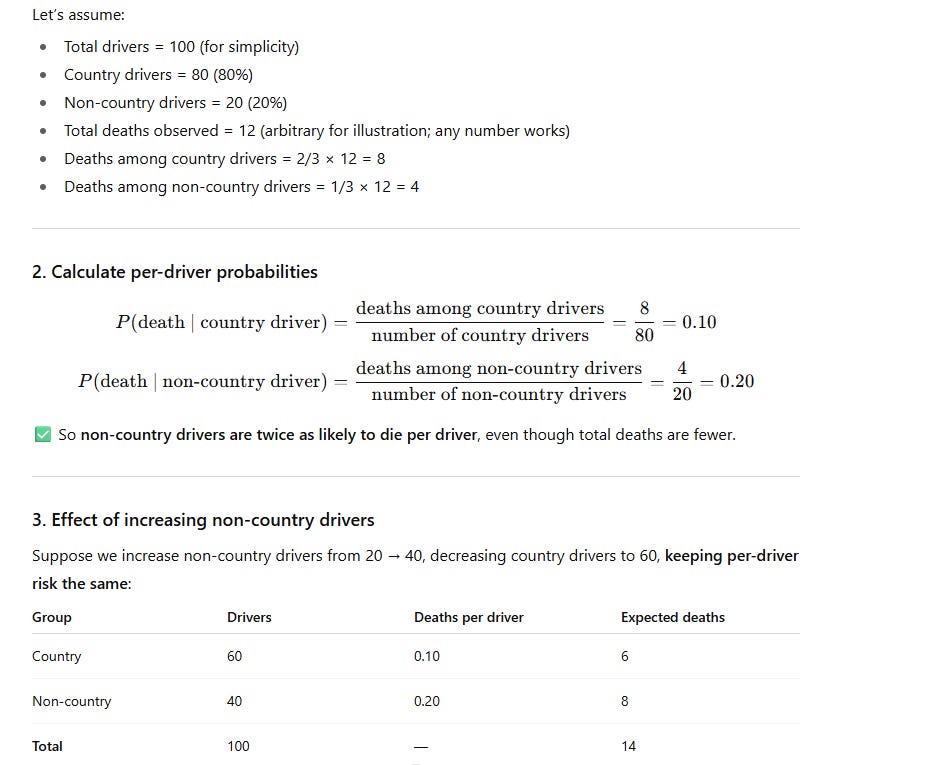
It is for this reason that if we adjust the cohorts - increase the number of, say, non-country people driving on country roads, there will be an increase in deaths and not a decrease, assuming that the 2/3 deaths statistic holds and that country drivers are less likely to be in car fatalities.
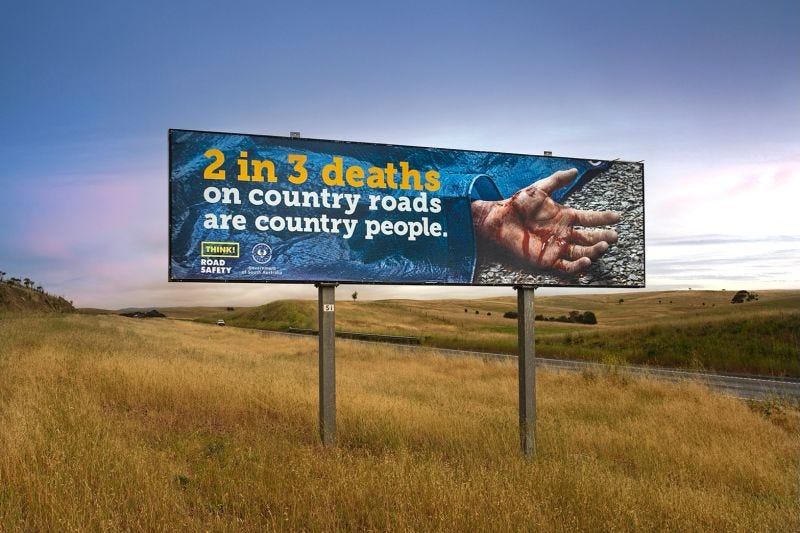
If 2/3 deaths on country roads are country people, 1/3 deaths on country roads do not involve country people. It follows that to change this ratio, there must be proportionately fewer country-resident driver deaths and proportionately more non-country-resident driver deaths. This is fine if it is reflective of an absolute decrease in deaths, but if the absolute death toll remains the same or even increases, the ratio is irrelevant. Suppose out of 500 drivers per year, 400 are country-residents and 100 are not, and there are 100 deaths. Suppose out of this, country-residents make up 67 deaths, which is 0.1675% of 400, and the remaining 33 are from non-country residents, which is 33% of 100. This satisfies the 2/3 ratio of country road deaths being country people, but it is highly misleading. Assuming that the death rate remains the same, doubling the number of non-country resident drivers would (1) increase the death toll and (2) simultaneously reduce the ratio of country resident road deaths. It also illustrates the opposite of what this ratio in the road sign predicts.
The Sharks in Shallow Waters Fallacy

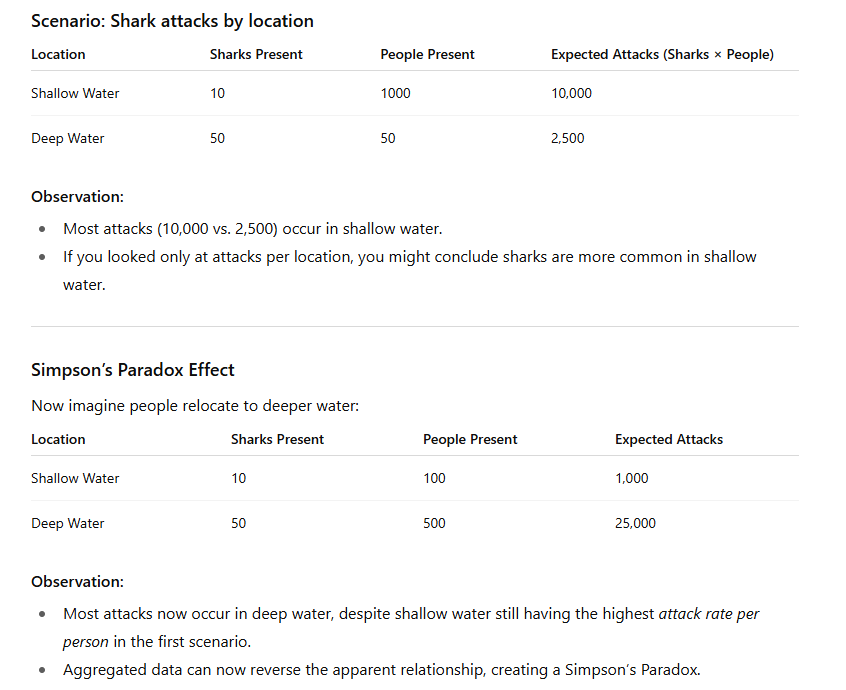
This is similar to the ‘sharks in shallow waters’ fallacy. To the extent that most shark attacks occur in shallow waters, this is not a reflection of where most sharks are but of where most people are. We risk creating a ‘Simpson’s Paradox’ if most people instead of being in the safe shores, relocate to where there are more sharks.
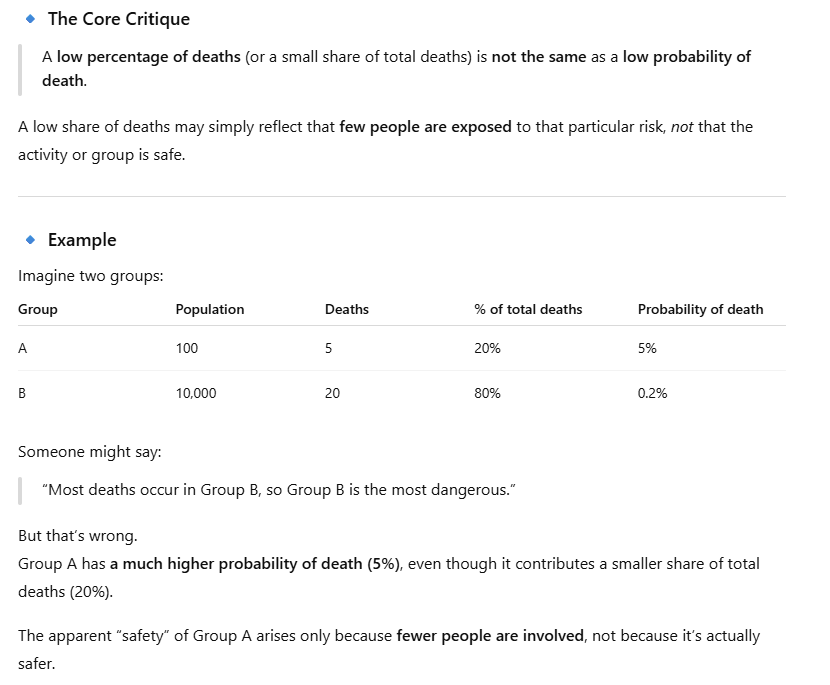
The Core of the Critique: Low Rates are not Necessarily Low Probabilities
The crux of this critique is not to confuse a low % death rate with a low probability of it happening. The low % may merely reflect a small population of the people involved in that particular incident.